
Local non-Profit organizations (NPOs) are the lifeblood of community development and the foundation of the global localization agenda. However, they frequently operate in high-pressure, resource-constrained environments that foster reactive rather than proactive organizational behaviors. A convergence of internal constraints and external pressures routinely undermines their operational viability.
Non-profit Institutional Systems Strengthening (NISS) Assessment Findings
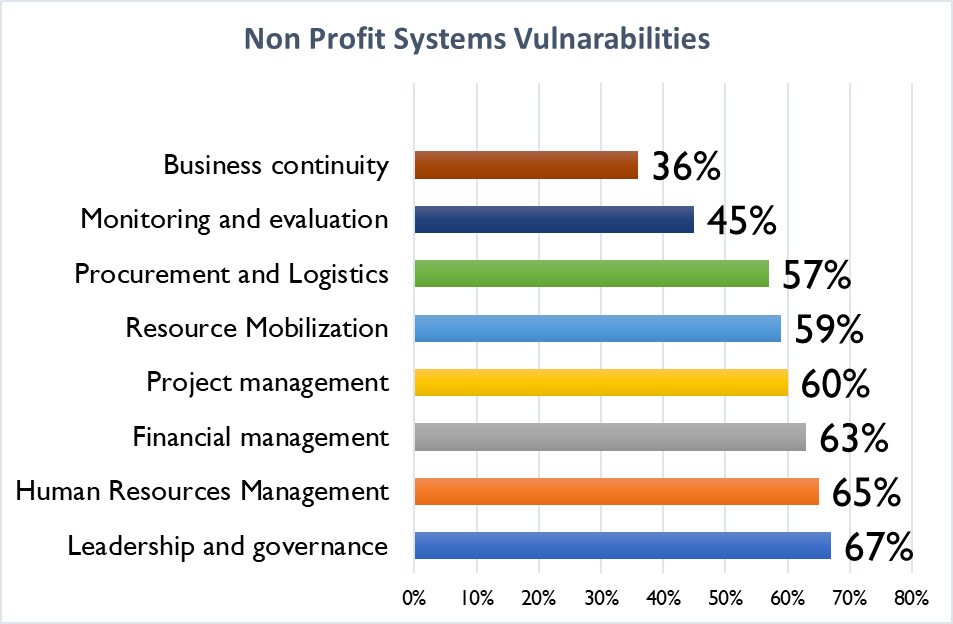
This assessment identifies a group of local NGOs that are purpose-driven and legally established, but facing significant institutional challenges that threaten their long-term sustainability. Key internal systems such as monitoring and evaluation, financial management, human resources, and business continuity are either weakly developed or inconsistently applied. Project and operational management practices are fragmented, and resource mobilization efforts remain largely inconsistent. The vast majority of organizations rely heavily on short-term donor funding, with little capacity to generate unrestricted income or plan for long-term continuity. These NGOs typically operate with minimal infrastructure and limited technical expertise, making them vulnerable to funding shocks, staff turnover, and leadership transitions. Risk management frameworks, succession planning, and multi-year budgeting are largely absent, further constraining resilience and strategic growth.
Highlights of the findings
Monitoring & Evaluation (M&E) Systems: M&E is the weakest one of the weakest organizational areas. Less than 43% have a functional M&E system and only 25% use indicator tracking tools, limiting learning, accountability, and evidence-based programming.
36%
only 36% can survive, they show resilience.
21+
We have assessed more than 21 organizations
75%
75% NGOs lack proposal writing capacity, donor relationship management systems, and fundraising teams undermining their ability to convert alignment into revenue.
Key Highlights
- Monitoring & Evaluation (M&E) Systems: M&E is the weakest one of the weakest organizational areas. Less than 43% have a functional M&E system and only 25% use indicator tracking tools, limiting learning, accountability, and evidence-based programming.
- Lack of major policies- local NGOs lack critical policies like safeguarding, gender, finance, HR, procurement policies. This makes the institutional framework weak.
- Financial Resilience: Organizations have not secured multi-year funding, and a mere and have no alternative income sources. The heavy reliance on short-term donor funding compromises operational continuity and flexibility.
- Resource Mobilization Gaps: Despite good alignment with national and donor priorities (75%), NGOs lack proposal writing capacity, donor relationship management systems, and fundraising teams undermining their ability to convert alignment into revenue.
- Inconsistent Project management and Operational Practices: Work plans, budget tracking, and staff-level planning tools are inconsistently applied. Project admin tools and adaptive management practices are notably weak.
- Procurement and Logistics Fragility: While procurement documentation exists in most NGOs, logistics systems (e.g., fleet tracking, staff safety, risk assessments) are significantly underdeveloped, leading to operational inefficiencies and vulnerabilities.
- Business Continuity Deficiencies: Most organizations cannot guarantee even one year of operational funding. Long-term staffing contracts and risk management mechanisms are rare, leaving NGOs exposed to sudden shocks.
- Human Resource Development: While employment basics are covered, formal HR systems (HRIS), development plans, and structured appraisals are weak. This stifles staff motivation, growth, and institutional continuity.
- Leadership Transition and Risk Governance: Lack of succession planning and organization-wide risk registers are threatening long-term leadership stability and risk mitigation ability of local NGOs
Implications of the Weak institutional systems
When these vulnerabilities are left unaddressed, they create a cycle of stagnation that threatens the organization's survival. Cash flow crises between grant cycles, high risk of compliance failures and inefficiencies, inability to track or prove actual community impact, over authoritative executive leadership and founder’s syndrome. In the long run, non-profit organizations chase donor priorities rather than serving core community needs. Without addressing the institutional systemic challenges, the organizations risk reputational damage leading to blacklisting by institutional funders, they consistently write uncompetitive grant proposals and fail to scale successful pilots, leading to high turnover, and an inability to adapt to regulatory changes. Ultimately, these factors trap local NGOs in a "subsistence loop." They are given enough project funding to execute specific tasks but are starved of the overhead and core operational funding required to build independent institutional capacity.
You can take an institutional assessment here to determine your systems strength and business continuity https://sus-afric.org/institutional-assessment
Strategic direction towards a lasting Impact and Social Legacy
Breaking the subsistence loop requires a fundamental shift from treating the NGO as a mere implementing partner to building it as an independent, viable enterprise. The organizations need to take the following key steps:
- Professionalize Monitoring and Evaluation: Establish M&E as a core organizational function by hiring qualified staff, building internal capacity, and integrating tools for digital data collection. Standardize indicator frameworks across projects to ensure consistent measurement of outcomes. This enables evidence-based decision-making, strengthens donor reporting, and fosters a culture of learning and accountability. Organizations must transition M&E from a "reporting mechanism" to a "learning engine." By investing in digital data collection and focusing on outcome-level indicators, leadership can make data-driven decisions that refine operational strategies. A robust, internally owned M&E framework not only improves program quality but serves as the ultimate marketing tool for future resource mobilization. Research, Monitoring & Evaluation Training | Sus-afric
- Cultivate Specialized Business Development Capacity: Non-profits must rethink their approach to growth by professionalizing their fundraising efforts. Cultivating dedicated business development specialists within the non-profit framework ensures that the organization isn't just writing proposals, but actively mapping stakeholder landscapes, building consortiums, and forecasting funding trends. Equipping leaders with these specialized skills provides the competitive edge needed to navigate complex, shifting funding landscapes successfully. Non Profit Business Development Training | Sus-afric
- Invest in Resource Mobilization: Create or strengthen teams dedicated to fundraising, donor engagement, and proposal development. Establish systems for tracking donor relationships and pipeline opportunities. By shifting from reactive to strategic fundraising, NGOs can diversify income streams and secure long-term sustainability.
- Ensure Organizational Resilience: Develop business continuity plans, secure multi-year funding for critical staff, and pursue unrestricted revenue sources through income-generating activities or strategic partnerships. This resilience allows NGOs to maintain operations during funding gaps, respond to emergencies, and invest in innovation without compromising core functions.
- Formalize Governance: Train board members, clarify their roles, and increase their involvement in decision-making. Develop key governance tools like succession plans, risk registers, and board performance evaluations. These measures foster accountability, strengthen strategic oversight, and safeguard organizational stability during transitions.
- Institutionalize Governance and Financial Protocols, Moving away from founder-syndrome requires establishing an active, independent Board of Directors that holds executive leadership accountable. Non-Profit Governance & Leadership Training | Sus-afric
- Organizations must institute rigorous internal capacity building; specifically, implementing structured grants and institutional finance management training can transform non-profit financial staff from passive administrators into strategic assets. Clear segregation of duties, regular external audits, and digitized financial tracking are non-negotiable for building funder trust. Grants and Financial Management Training | Sus-afric.
- Build HR Infrastructure: Invest in formal HR systems, including digital platforms (HRIS), structured performance evaluations, and staff development plans. This improves recruitment, retention, and team motivation while reducing turnover. Strong HR practices ensure continuity, institutional memory, and the professionalization of operations.
You can enroll for Social Legacy program NGOs. CSOs capacity strengthening NGOs. CSOs capacity strengthening https://sus-afric.org/slides/non-profit-capacity-strengthening-2
